 Liquifi
 calculates net token payouts using claimable amounts and configured withholding
Liquifi, now Coinbase Token Manager, subtracts configured tax withholding from claimable tokens to determine a recipient's net payout. The calculation applies to tokens that have vested and unlocked, rather than the entire grant. Withheld tokens stay in the account's source wallet. The company and its payroll provider handle tax remittance separately, using the tax policy and rates that they establish.
A payout calculation connects the grant schedule, the token price method, and the applicable withholding rate. Each input needs to describe the same event. An accurate subtraction won't correct a withholding rate that belongs to a different payout.
Key takeaway: A payroll valuation can change without changing net tokens when the claimable quantity and withholding percentage stay fixed.
Claimable tokens as the withholding base
The claimable quantity determines how many tokens enter the withholding calculation for an event. A grant's total allocation can include tokens that haven't vested, or vested tokens that remain locked. Those amounts don't enter that event's claimable balance. Vesting and lockup schedules therefore affect the calculation before the administrator applies a tax rate.
A token grant connects its recipient with an allocation, dates, and release schedules.
The gross-to-net calculation
The calculation splits an event's claimable token quantity into a retained portion and a recipient portion. A separate price calculation expresses the gross token event in fiat currency. Keeping those units explicit prevents confusion between a token deduction and an income valuation.
Token quantities
Let
C
represent the event's claimable token quantity and
r
its configured withholding percentage. The percentage applies to the claimable quantity for that event.
Withheld tokens
withheld = C * r / 100
gives the token quantity retained for tax funding. The administrator supplies the applicable rate through the grant settings or a permitted event-specific override.
Net tokens
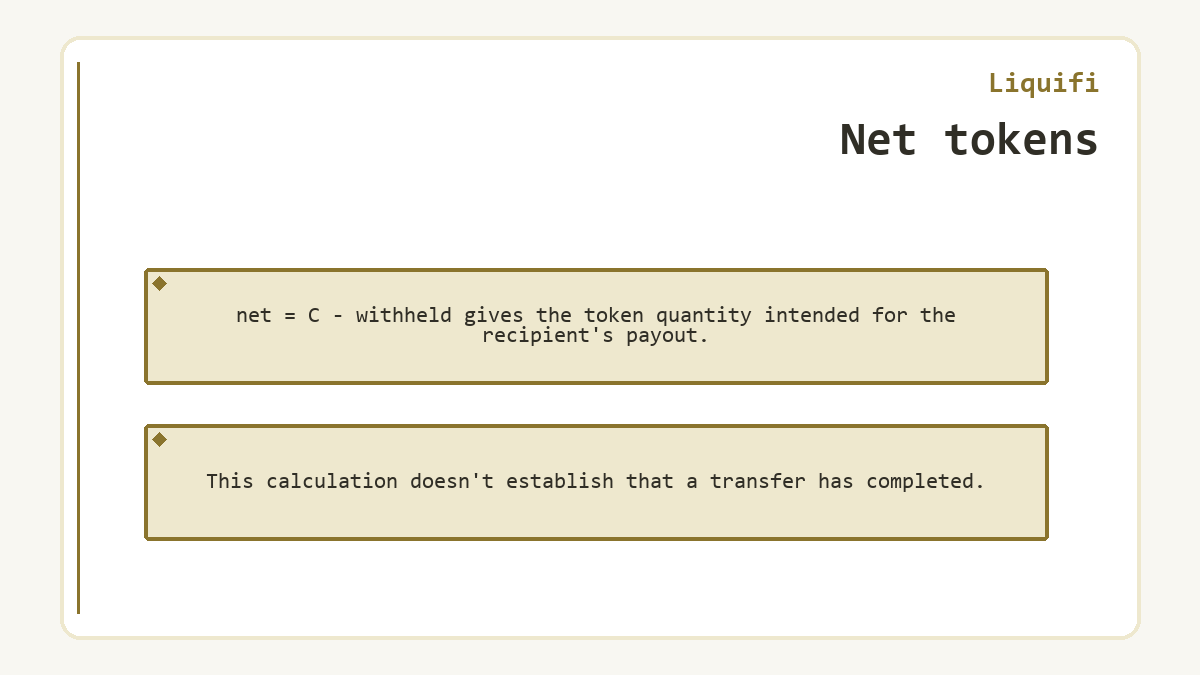
net = C - withheld
gives the token quantity intended for the recipient's payout. This calculation doesn't establish that a transfer has completed.
Fiat valuation
Gross fiat income equals the claimable token quantity multiplied by the selected price per token. That price must use the company's agreed valuation method. Token Manager supports a market-sourced price or a custom value. A token quantity and its fiat valuation describe different aspects of the same event; neither should replace the other in payroll reconciliation.
The source wallet after withholding
Withheld tokens remain in the source wallet of the Token Manager account. The company retains responsibility for managing those tokens toward its tax obligations. Token Manager calculates the retained and net quantities from configured inputs. The company and payroll provider handle tax remittance, payslips, and year-end forms. Retaining tokens doesn't establish that a tax authority has received a payment.
Can the token price change without changing the net token amount?
A different token price leaves the net token quantity unchanged when the claimable quantity and configured withholding percentage stay fixed. The gross fiat valuation changes.
A payroll valuation needs a price method that fits the provider's calculation schedule. The supported choices include market pricing and custom reference values. Delivery-time pricing has a narrower practical application when the provider normally needs an advance valuation.
| Price method | Valuation input | Use in the calculation | Payroll timing condition |
|---|---|---|---|
| Market-sourced price | Token price from market data, including CoinMarketCap | Converts claimable tokens into gross fiat income | Event-specific payroll rates still require the provider's turnaround time. |
| Prior-day close | Custom price using the agreed previous-day closing value | Provides a reference valuation before delivery | The provider must have enough time to return the withholding rate. |
| Specific intraday timestamp | Custom price at an agreed point during the day | Values the event using the chosen timestamp | The timestamp must fit the provider's calculation lead time. |
| Delivery-time price | Token value at delivery | Can fit an advisor-approved flat-rate withholding policy | Usually impractical when payroll must calculate a new rate from an advance valuation. |
A payroll provider may return a different withholding percentage after evaluating a different fiat value. Applying that revised percentage changes the token split. The price itself isn't an extra token deduction.
Payroll lead time before distribution
The payroll provider's turnaround time determines how early the company needs a usable fiat valuation for event-specific withholding. That timing governs the price methodology that the company agrees with its tax advisor. A reference price taken before delivery can give payroll time to return the rate that the administrator needs.
The per-payout workflow for Restricted Token Units (RTUs) starts with custom token pricing enabled. Its initial grant setup can leave the withholding rate unset because the administrator will add the event's rate later. That arrangement belongs to a workflow that obtains rates for individual distributions; it isn't a universal default for every grant.
Before distribution, the administrator enters the price calculated under the agreed method in the payout flow. The administrator then downloads its CSV and sends it to the payroll provider. On the payout day, the administrator updates the withholding rates using the provider's response. The provider's turnaround time determines when the earlier preparation must occur.
Grant-level entries and event-specific overrides
Administrators can enter a withholding rate while creating a grant in the app or through the bulk grant creation template. Individual grant creation also includes a price calculation method, with optional withholding and price inputs where the company's process requires them. These settings need to reflect the award and the tax policy that apply to that recipient.
An administrator can override the withholding percentage for a particular payout event when internal policy permits it. The administrator makes that change before finalizing the payout. This supports updated payroll instructions without treating an earlier grant-level rate as permanent. A payout-specific adjustment and a reusable vesting template have different purposes: the adjustment changes that event's withholding, while the schedule describes when tokens vest or unlock.
Employee awards and other stakeholder categories
Token withholding usually applies to employee Restricted Token Units (RTUs) or similar awards. Token purchase awards, contractors, investors, and advisors don't usually follow that employee withholding treatment. The company's tax policy, informed by its advisors, determines whether withholding applies to a particular recipient or award. An allocation appearing in the same cap table doesn't establish that it shares another recipient's rate or tax treatment.
Rate histories when circumstances change
Accurate rate histories matter when a recipient's circumstances change over time. Employee mobility and role changes can affect the tax instructions that apply to an event. A calculation using an outdated rate can produce a mathematically consistent deduction that doesn't match the tax team's intended treatment.
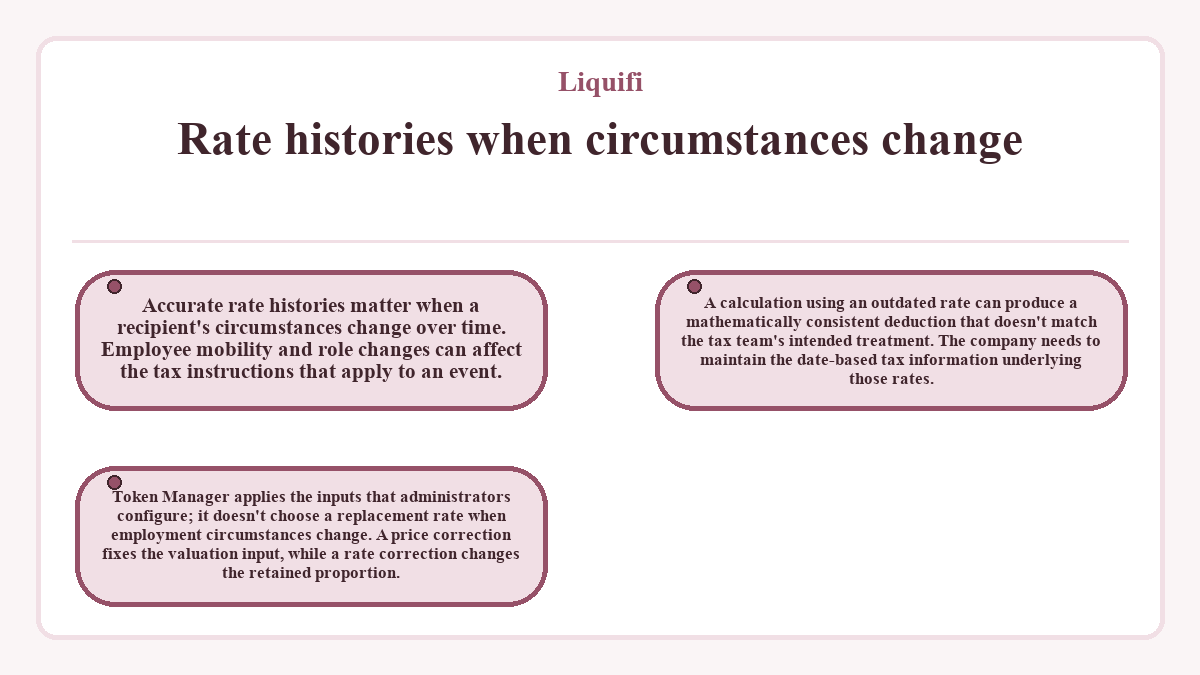
The company needs to maintain the date-based tax information underlying those rates. Token Manager applies the inputs that administrators configure; it doesn't choose a replacement rate when employment circumstances change. A price correction fixes the valuation input, while a rate correction changes the retained proportion.
Net payout instructions and completed transfers
The net quantity describes the intended token delivery, while funding and transfer execution determine whether those tokens arrive. Token Manager coordinates payouts through the account's configured wallets or custody integration. A custody-based setup needs its required API access and any applicable address or approval configuration. The administrator also needs sufficient tokens in the funding source.
Full withholding produces a zero-token net amount. Some custody APIs may reject zero-amount payouts, so an operational workaround may be necessary.
Token payout records and payroll reconciliation
Token Manager logs net payout amounts for reporting and reconciliation, and its structured exports connect token operations with payroll processing. Those records help finance teams relate a distribution to the amounts used in the withholding calculation. Payroll handles the employment information, fiat tax remittance, and supported payslip reporting that complete the wider process.
A net token amount is a quantity of tokens. A payroll income amount expresses value in fiat currency. A tax remittance is a separate fiat payment to a tax authority. Keeping those meanings intact makes differences easier to investigate without mistaking a retained token balance for a completed tax payment.
A company can assemble payroll inputs manually in spreadsheets. Structured exports provide data from the token payout flow for the payroll provider to process. The company and provider still determine how their tax calculations and filings operate within the payroll cycle.
Liquifi: the short answers
Who determines the tax jurisdiction for a token withholding grant?
The company must establish the applicable tax jurisdiction using guidance from its tax and legal advisors. Token Manager applies the configured values and doesn't determine which jurisdiction governs an award.
Do recipients have to claim tokens manually for withholding to apply?
Configured withholding can apply to administrator-initiated payouts, so recipients don't always need to claim manually. The company decides how it releases tokens. Direct claims require the organization to enable that feature, and the tokens must satisfy vesting and applicable lockup conditions. A recipient should ask the grant administrator which distribution method applies.
Are network fees included in the withholding percentage?
Network gas fees and token tax withholding are separate amounts. When the company transfers tokens directly, it generally pays the transfer's gas fee. A recipient who claims tokens personally generally needs the network's native token to pay gas. The configured withholding percentage calculates the portion of claimable grant tokens retained for tax funding.
Does token withholding require Deel as the payroll provider?
Token withholding doesn't require Deel as the payroll provider. The workflow accommodates other payroll providers through structured data exports. The company must confirm that its provider supports the relevant employee and grant details, then align the valuation method with the provider's turnaround time.
Will a bank conversion use the same price as the payroll valuation?
A bank conversion uses the third-party provider's quoted exchange rate and fees, which can differ from the payroll valuation. Cash conversion requires the organization to enable a supported integration, and the provider may require identity verification and a linked bank account. The conversion confirmation identifies the fiat amount to be sent.